Where should your downspouts drain?
Published
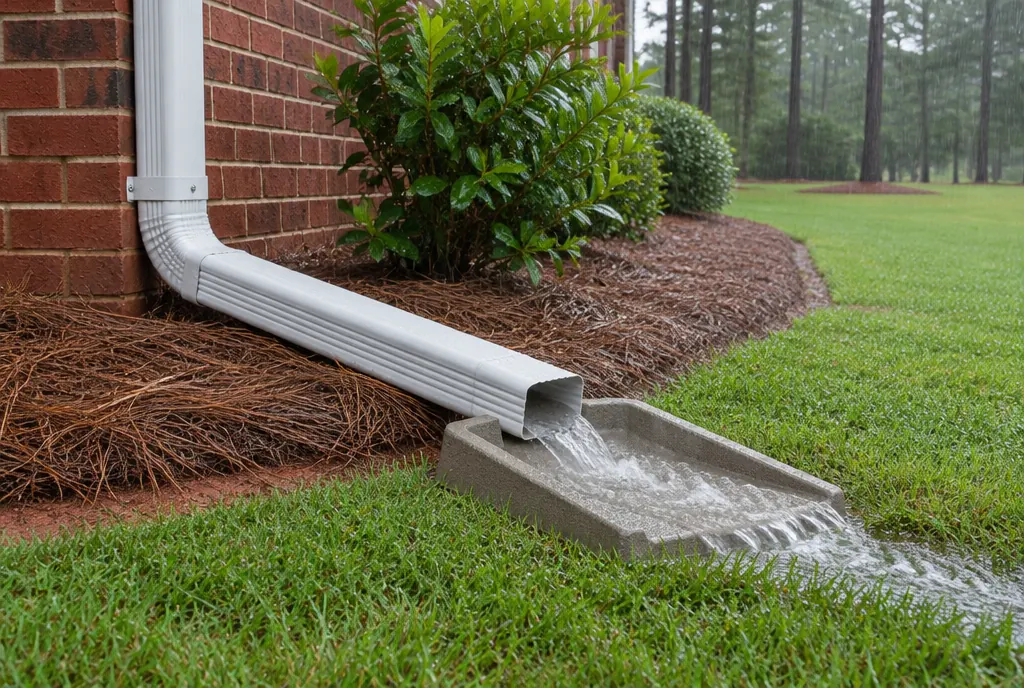
A downspout should empty at least 4 to 6 feet from the foundation, onto ground that slopes away from the house. Farther is better. The one place it should never empty is right at the base of the wall, which is where a lot of them do.
Gutters collect every drop that lands on the roof and deliver it to a few points on the ground. If those points are next to the foundation, the gutters are concentrating the water in the worst place.
Why it matters more in Georgia
Georgia red clay soaks up water slowly. In a hard rain it can't take the water in as fast as the downspout delivers it, so the water sits against the house or runs along the surface looking for a low spot.
That low spot is often a crawl space vent, a basement wall or the corner of a slab. Wet crawl spaces, damp basement walls and washed-out beds around Atlanta homes very often trace back to a downspout that ends at the wall.
Four ways to carry the water away
Splash blocks
A splash block is the plastic or concrete tray under the downspout. It spreads the water out and stops it from digging a hole. It moves water about two feet, which is better than nothing but not far enough by itself. It works when the ground already slopes well away from the house.
Downspout extensions
An extension is a length of downspout or a flexible pipe attached to the bottom elbow, running 4 to 6 feet out into the yard. It is the cheapest fix that works, and for many homes it is all that is needed.
The downsides are practical. Extensions get in the way of the mower, get stepped on, and get kicked loose. A hinged extension that flips up for mowing helps, as long as someone flips it back down.
Buried drain lines
Here the downspout connects to a solid pipe underground that runs to a spot well away from the house, often 10 feet or more, and comes out at a pop-up emitter or at the curb. Nothing to trip over and nothing to move for the mower.
Two things make a buried line work. It has to slope downhill the whole way, and it has to stay clear. A buried pipe full of pine needles backs water straight up into the gutter, so a cleanout near the house and a leaf filter at the downspout are worth adding.
Rain barrels and rain gardens
A rain barrel catches water for the garden. It is useful, but a barrel fills in one good storm, so it needs an overflow that carries the extra water away. A rain garden is a shallow planted dip in the yard, set well away from the house, where water can collect and soak in slowly.
Which one fits your house
Start with the slope. Pour a bucket of water where the downspout ends and watch where it goes.
If it runs away from the house, an extension or a splash block with an extension is enough. If it sits there or runs back toward the wall, the ground needs regrading, or the water needs to be piped past the low spot with a buried line. For a downspout that empties onto a walkway or driveway, a buried line under the path keeps it from turning slick with algae or icing over in winter.
Places a downspout should not drain
- Right at the foundation
- Onto a neighbor's property
- Across a sidewalk or steps
- Into a septic drain field
- Onto a lower roof without a gutter there to catch it
It is also worth checking your city or county rules before connecting a downspout to a storm drain or the street. They differ around Metro Atlanta.
How many downspouts you need
Drainage problems are sometimes a counting problem. A long gutter with one downspout sends all its water to one corner of the house. Adding a second downspout halves what each one carries and makes both easier to drain properly. A common rule of thumb is one downspout for every 30 to 40 feet of gutter.
Common questions
How far should a downspout extend from the house?
At least 4 to 6 feet. On flat lots or clay soil, 10 feet is better.
Is it OK for downspouts to drain into the yard?
Yes, as long as the water ends up well away from the house and doesn't run onto a neighbor's lot.
Do buried downspout drains clog?
They can. A leaf filter at the downspout and a cleanout near the house make them easy to keep clear.
Water pooling by the foundation?
We add, reroute and extend downspouts so the water ends up away from the house. Book online to have your downspouts and drainage looked at anywhere in Metro Atlanta.