5-inch or 6-inch gutters: which does your roof need?
Published
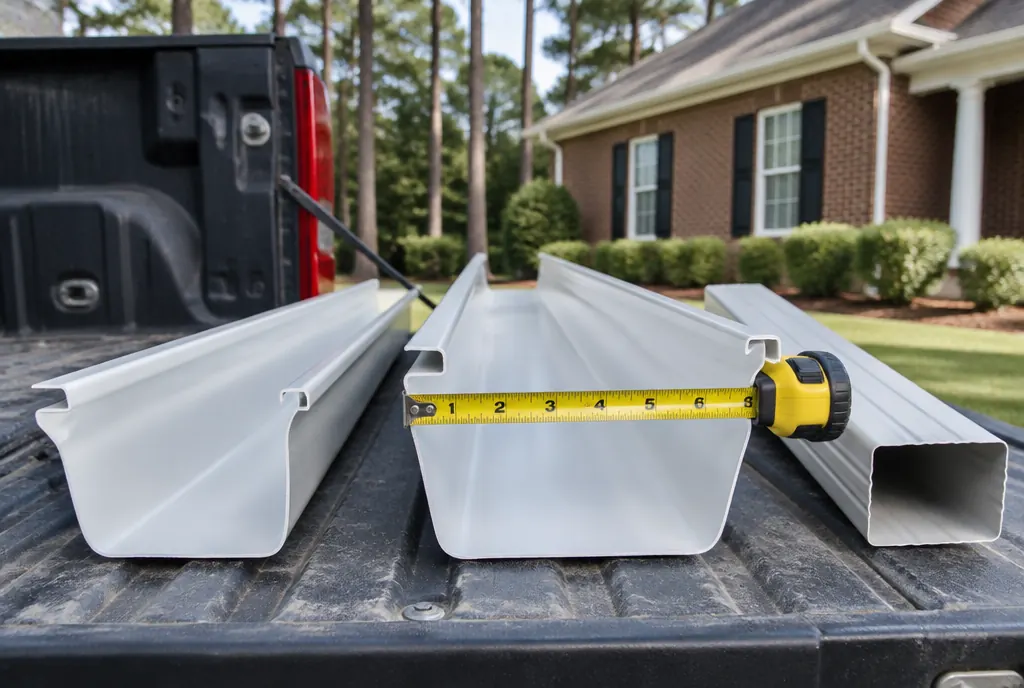
Most homes do fine with 5-inch gutters. A 6-inch gutter carries roughly 40 percent more water, and it is the right choice when a lot of roof drains to one edge, when the roof is steep, or when your current gutters overflow even though they are clean.
The inch measurement is the width across the top of the gutter. One inch doesn't sound like much. But the 6-inch gutter is deeper as well as wider, which is where the extra capacity comes from.
What decides gutter size
Three things, and we check all of them before quoting.
How much roof drains to that gutter. A gutter doesn't care how big the house is. It cares how many square feet of roof slope toward it. A long, deep roof plane sends far more water to its gutter than a small porch roof does.
How steep the roof is. Water comes off a steep roof faster and with more force. On a steep pitch it can shoot past the front of a 5-inch gutter in a heavy storm. The wider 6-inch opening catches it.
How hard it rains. Atlanta gets about 50 inches of rain a year, and much of it comes in short, heavy summer downpours. Gutters have to be sized for the hardest ten minutes of a storm.
When 5-inch gutters are the right fit
- One-story ranch homes with simple roof lines
- Roofs with a low or moderate pitch
- Short runs where the water doesn't have far to travel to a downspout
- Homes where the existing 5-inch gutters have never overflowed when clean
Five-inch K-style is the most common gutter on Atlanta homes for a reason. On an ordinary roof it handles the water without any trouble.
When 6-inch gutters are worth it
- Two-story homes with large roof planes
- Steep roofs
- Roof valleys, where two slopes meet and pour into one spot
- Long runs with only one place to put a downspout
- Metal roofs, which shed water faster than shingles
- Clean gutters that still overflow in a hard rain
That last one is the clearest sign. If the gutters are clear, the slope is right and water still goes over the front edge, the gutter is too small for the roof.
Don't forget the downspouts
Gutter size is only half of it. The downspout is where the water leaves, and a big gutter with a small downspout backs up.
Five-inch gutters usually pair with 2x3 inch downspouts. Six-inch gutters pair with 3x4 inch downspouts, which have twice the opening. The larger downspout also passes leaves and pine needles that would jam a smaller one, which matters under Georgia pines.
Sometimes the fix for an overflowing gutter is another downspout, or a larger one, without changing the gutter at all. That is a cheaper repair, so we look at it first.
Can you mix sizes on one house?
Yes, and it is common. A house might have 6-inch gutters on the big rear roof plane and 5-inch on the front porch and garage. From the ground the difference is hard to see, especially when the color matches the trim.
How they look
Six-inch gutters are slightly more visible. On a two-story home or a house with wide trim boards they look in proportion. On a small one-story home with narrow fascia they can look heavy. The fascia board also has to be tall enough to mount the larger gutter properly.
Common questions
Are 6-inch gutters better than 5-inch?
Only if your roof needs the capacity. On a small or low-pitch roof a 6-inch gutter works no better than a 5-inch one.
Do 6-inch gutters clog less?
Somewhat. The wider trough and larger downspouts pass more debris, but they still need cleaning.
How do I know what size I have now?
Measure straight across the top of the gutter from the back edge to the front lip. It will be close to 5 or 6 inches.
Not sure what your roof needs?
We measure the roof planes, check the pitch and look at where the downspouts can go before recommending a size. Book online or read about gutter installation in Metro Atlanta.